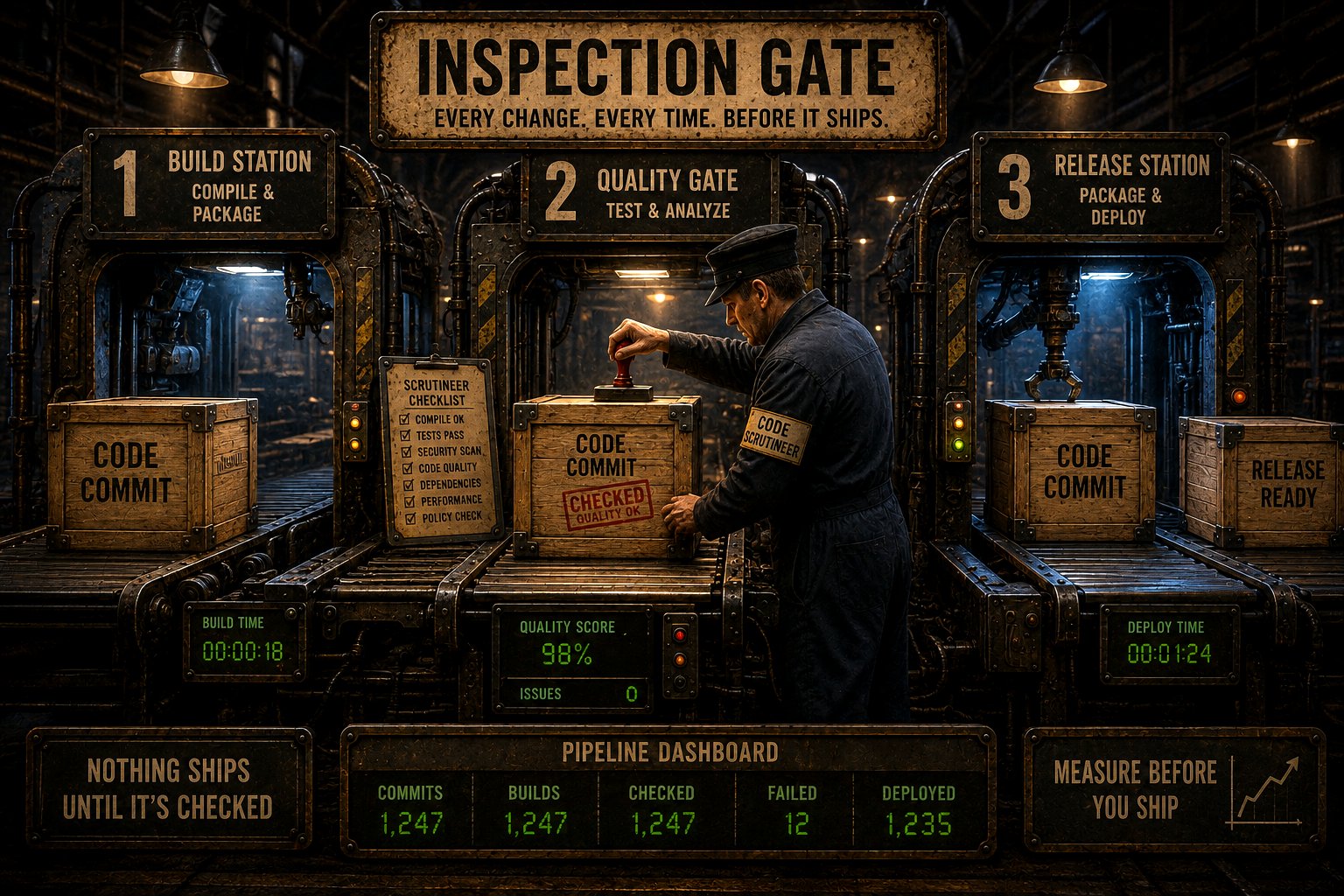
The trio moves your code from commit to cluster. None of the three can tell you what actually changed on the way through — how much of the diff a developer wrote, how much a lockfile or an AI agent produced, and whether that should block the merge. That measurement slots into the pipeline as one container image.
If you landed here from a search, the division of labour is simpler than most explainers make it: Jenkins is the orchestrator — it notices a commit and runs your pipeline, stage by stage. Docker is the packaging — it freezes an application and its dependencies into an image that runs identically everywhere. Kubernetes is the runtime — it keeps fleets of those containers running, restarted and scaled. Jenkins builds it, Docker boxes it, Kubernetes runs it.
All three move code; none of them looks at it. A pipeline can build, containerise and deploy a 5,000-statement change without anyone learning that 4,900 of those statements came from a regenerated lockfile, or that the change quietly added a call to a foreign-hosted AI model, or that an agent’s credentials got committed alongside it. CI status is green; the questions that matter to an engineering manager — what changed, who or what wrote it, does it carry risk — are simply never asked.
CodeDelta asks them deterministically: a compiled C++ engine diffs two versions of a tree and counts changed, deleted and added logical statements (not lines), separates authored churn from generated churn (TRUE_CHURN), and scans for AI-agent code, egress to foreign-hosted models and committed agent credentials. Same input, same numbers, every run — no sampling, and the churn arithmetic involves no ML.
The engine ships as a public Docker image, so a Jenkins stage needs no tool installation — just Docker on the agent. This reference stage compares the workspace against the main branch and fails the build (the engine exits 3) when gated findings appear:
# Jenkinsfile (declarative) - reference recipe
pipeline {
  agent any
  environment {
    // base64 of your codedelta.lic, stored as a Jenkins secret-text credential
    CODEDELTA_LICENSE_B64 = credentials('codedelta-license-b64')
  }
  stages {
    stage('Churn + agent gate') {
      steps {
        sh '''
          git worktree add --force /tmp/base origin/main
          docker run --rm \
            -v "$WORKSPACE:/work" -v /tmp/base:/base \
            -e CODEDELTA_LICENSE_B64 \
            ghcr.io/code-delta-app/codedelta \
            scan /work /base --mode churn_agent --html --csv --gate
        '''
      }
    }
  }
}
Exit code 3 means a policy violation — by default, egress to sanctioned-country model providers or executable-on-model artifacts — and Jenkins fails the stage. Add --write-baseline once and then --baseline <file> --fail-on-new to block only new findings, which is how you introduce a gate to an existing codebase without relitigating history. The reports (churn, AI audit, agent scan) land in the workspace as HTML and CSV for archiving.
This is the live path most corporate users take — hardened CI that forbids installing tools but allows approved images. The image is public on GHCR and republished with every release; the licence rides in as an environment variable:
export CODEDELTA_LICENSE_B64=$(base64 -w0 codedelta.lic)

docker run --rm -v "$PWD:/work" -e CODEDELTA_LICENSE_B64 \
  ghcr.io/code-delta-app/codedelta \
  scan /work/new /work/old --mode both --html --csv
The container holds the compiled engine and everything it needs — no Python, no dependency resolution, no network calls during the scan. Everything executes against the trees you mount; nothing leaves the machine.
CodeDelta is a build-time measurement, not a service, so it does not deploy to Kubernetes — it runs on it, the same way your K8s-hosted CI agents do. Two patterns are useful. First, if your Jenkins agents (or Tekton/Argo runners) are pods, the Docker recipe above works unchanged inside them. Second, a scheduled snapshot scan of a repository — agent detection and AI audit on a cadence, reports to a volume:
# reference recipe - weekly snapshot scan
apiVersion: batch/v1
kind: CronJob
metadata:
  name: codedelta-weekly-scan
spec:
  schedule: "0 6 * * 1"
  jobTemplate:
    spec:
      template:
        spec:
          restartPolicy: Never
          containers:
          - name: codedelta
            image: ghcr.io/code-delta-app/codedelta
            args: ["scan", "/repo", "--mode", "ai_audit", "--html", "--csv"]
            env:
            - name: CODEDELTA_LICENSE_B64
              valueFrom:
                secretKeyRef: { name: codedelta-licence, key: license-b64 }
            volumeMounts:
            - { name: repo, mountPath: /repo }
          volumes:
          - name: repo
            persistentVolumeClaim: { claimName: repo-checkout }
Run weekly, this gives you a longitudinal record of AI involvement and agent artifacts in the tree — the trend that a single PR-sized snapshot cannot show.
This is real output, not a mock-up — the comment CodeDelta’s own gate posted on the live public demo pull request on 1 August 2026, running the released engine against a PR whose diff was six authored statements plus a regenerated lockfile:
CodeDelta report

Churn: 96 logical statements (+6 / −0 / Δ90); REP_CHURN 0.06
TRUE_CHURN: 6 authored — the other 90 (94% of the total)
            came from 1 generated file

AI audit:   0 HIGH · 1 ELEVATED · AI 6% of added code
Agent scan: 0 CRITICAL · 3 HIGH · 8 ELEVATED
Governance: 4 file(s) send data to foreign-hosted models
            (4 non-allied); 1 file(s) call AI inside a loop
Agent infrastructure: 6 artifact(s) in the tree — 2 tier-3
            (rogue residue / credentials)
Ninety-four percent of that diff was machine-produced. A reviewer reading only the raw diff size would have concluded a substantial change; the measurement says six statements of human work. That distinction — on every PR, deterministically — is the point.
The CLI page covers every run path (GitHub Action, Docker, Codespaces, local, other CI) with copy-paste commands. Downloads for Windows, macOS and Linux are on the download page — free to evaluate, fully unlocked, until 31 October 2026.
Every measurement in this piece was made with CodeDelta — statement-level churn, AI-agent detection and the AI-BOM, on macOS, Linux and Windows, free to try. Download CodeDelta → or add it to every pull request.